Hire Fire Show in Riyadh: Cost, Permits and Booking Guide
A fire show in Riyadh is a live performance built around flaming props, poi, fans, staffs, fire breathing and fire eating, delivered by trained performers who travel in specifically for the event. Before anything is lit on site, the act needs sign off from Saudi civil defense and an event permit route through the General Entertainment Authority (GEA). Cost depends on act size, flight origin, season and venue type rather than a flat rate. Riyadh Season, roughly October through March, is the busiest booking window. Alcohol is not a factor to plan around, since Saudi Arabia is fully dry nationwide.
- What a fire show in Riyadh looks like on the night
- When to book a fire show in Riyadh
- What determines the cost of a fire show in Riyadh
- Permits, visas and local rules for a fire performer
- Technical rider: what the venue must provide
- Venue types in Riyadh and what changes for fire acts
- How the booking process works
- FAQ
What a Fire Show in Riyadh Looks Like on the Night
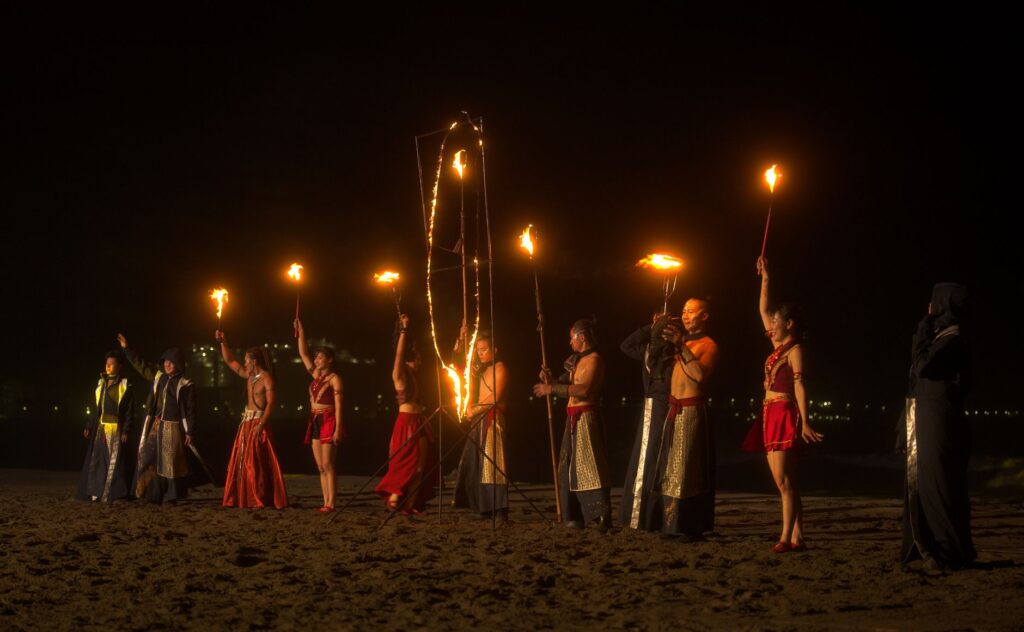
A typical fire act runs ten to twenty minutes, often split into two shorter sets with a costume or prop change in between rather than one long block. Expect a mix of poi, staff, fan and hoop work, sometimes paired with fire breathing or fire eating as a closing moment. Many clients in Riyadh book a fire show alongside an acrobatic or dance element, since the two disciplines share rehearsal time and a fire finale lands well after an acrobatic show segment. Exact running time, number of performers and whether the act is solo or a duo should be fixed in the contract, because civil defense approval is tied to the specific act description, not a general category of "fire performance."
When to Book a Fire Show in Riyadh
Riyadh Season, which runs roughly from October to March, is when most large entertainment events happen and when international acts are already in the region, which helps both cost and availability. Outside that window, two things work against you: the summer heat, which reaches well above 40 degrees Celsius and makes outdoor flame performance genuinely risky for fuel handling and performer safety, and Ramadan, during which live performance bookings of this kind drop to almost nothing out of respect for the fasting month. If your event date falls in summer or during Ramadan, confirm with your venue and the organiser's compliance team whether the performance will even be approved before you contract flights.
Lead time matters more here than in markets where entertainment permitting is lighter touch. We recommend six to eight weeks between confirming the act and the event date, to leave room for the civil defense review and the GEA permit to clear without rushing anyone.
What Determines the Cost of a Fire Show in Riyadh
There is no published flat rate for a fire show in Riyadh, and anyone quoting one off the top of their head without knowing your dates, venue and act size is guessing. What actually moves the number is a short list of fixed components.
| Cost Component | What It Depends On |
|---|---|
| Performance fee | Number of performers, set length, whether the act is solo or an ensemble |
| International flights | Origin city, how far out you book, number of performers travelling |
| Accommodation | Nights needed, which usually includes a rehearsal or travel day either side of the show |
| Per diem and local transport | Length of stay, whether the venue provides ground transport |
| Local crew and fire marshal | Whether the venue has an in-house fire safety officer or one must be brought in |
| GEA permit and civil defense review | Venue type, whether the performance is indoor or outdoor, and how quickly the paperwork is filed |
| Costume and prop fireproofing | Whether props and costume need fresh fire-retardant treatment or certification for this event |
| Rehearsal or technical day | Whether the venue requires a walkthrough before the live show, which most do for open flame acts |
We quote per event once we know the date, venue type, performer count and whether it is indoor or outdoor, because the permit and crew line items genuinely shift between those scenarios. If you are comparing markets, our guide to hiring a fire show in Doha breaks down how the permit process and cost structure differ there, which is useful if you are weighing Riyadh against another Gulf city for the same event series.
Permits, Visas and Local Rules for a Fire Performer in Riyadh
Two separate approvals apply to a fire act in Saudi Arabia, and skipping either one is the single most common reason a booked show gets pulled at short notice. First, the General Entertainment Authority handles the event permit for public and private entertainment events, and most legitimate venues and organisers will already have a process for this. Second, and specific to open flame, Saudi civil defense needs to review and approve the act itself, including the specific props, fuel type and performance footprint, separately from the general event permit. This review typically needs to start three to four weeks before the event, not the week of.
Performer entry is usually arranged through a work visit visa tied to an invitation from the event organiser, rather than a standard tourist entry, since the performer is working. Processing this alongside the permit, rather than after it clears, is what keeps the whole timeline inside six to eight weeks.
A few local realities to plan around rather than be caught out by:
- Saudi Arabia is dry nationwide. There is no licensed alcohol service at any venue, unlike Doha or Dubai, so no part of your planning needs to account for bar service timing around the act.
- Costume needs sign off in advance. Fire costumes designed for other markets are often too revealing for Saudi norms, and a costume rejected on arrival is a problem you cannot fix same day. Share costume references with the organiser during contracting, not during load in.
- Prayer times can affect the show schedule. Large public events commonly build a pause around adhan into the run of show, and your performer's set time should be fixed with that in mind rather than assumed.
Rules in this space do shift, and the organiser or venue compliance team will have the current requirement for your specific event type. Treat anything we write here as the baseline to ask about, not the final word for your date.
The most expensive mistake: booking flights and confirming an artist fee before civil defense has reviewed and approved the specific act, props and fuel type. If the review comes back with a condition you cannot meet, or does not clear in time, you are still on the hook for the artist's fee and non-refundable flights, and you have no show to put in front of your client. Get the permit and civil defense sign off moving in parallel with contracting, never after.
Technical Rider: What the Venue Must Provide
A fire act's technical rider is shorter than a full production act, but every item on it is a safety requirement, not a preference, and civil defense will often check for exactly these things during their review.
- A clear performance footprint with safe clearance from drapes, flags, florals and any other flammable dressing. The exact distance is confirmed by the fire safety officer reviewing your specific act, not a fixed universal number.
- A fire extinguisher and either a water bucket or sand bucket at the performance area, attended by someone trained to use it, not just placed nearby.
- A non-flammable floor surface, or protective covering if the natural floor is carpet, wood or synthetic turf.
- For indoor venues, confirmation that the space has adequate ventilation or smoke extraction, and that overhead sprinkler or smoke detection systems are either compatible with brief open flame or formally disabled for the performance window with the venue's engineering team.
- If outdoor, a wind reading ahead of the set. Strong wind is one of the few things that can force a last minute change to the act, and this should be a known contingency in the run of show, not a surprise.
We send a written rider to the venue as part of contracting, and we ask for written confirmation back rather than a verbal yes, since the civil defense review usually wants to see that document too.
Venue Types in Riyadh and What Changes for Fire Acts
Riyadh's major venue categories for this kind of booking are hotel ballrooms, outdoor compound or garden settings, and desert venues outside the city, and each changes how the fire approval and staging actually work.
| Venue Type | What Changes for a Fire Act |
|---|---|
| Hotel ballroom | Ventilation and sprinkler compatibility need confirming early, fire safety officer usually provided by the hotel |
| Outdoor garden or compound | Wind contingency plan needed, ground surface check for grass or decking |
| Desert venue outside the city | Generally the easiest setting for open flame approval, but power, lighting and a fire marshal usually need to be brought in rather than assumed on site |
| Rooftop | Least straightforward for fire due to wind exposure and building fire code, confirm feasibility with the building's fire safety team before contracting the act |
We do not quote specific venue capacities, layouts or fire clearance distances here, because those are set by the venue itself and its fire safety officer, and they vary property to property even within the same category. Confirm them directly with your venue before finalising the act's footprint.
If the venue's rules end up ruling out open flame entirely, which does happen with some rooftop and heritage properties, a drone show is one of the few alternatives that delivers a similar visual finale without any open flame on site, and it is worth raising as a backup option early in planning rather than after the fire act has already been turned down.
How the Booking Process Works
We run this the same way for every Riyadh fire booking, and the order matters more than the speed of any single step.
| Step | Typical Timing Before Event |
|---|---|
| Confirm act, set length and performer count, sign contract | 6 to 8 weeks |
| Submit act details for civil defense fire safety review | 5 to 6 weeks |
| File GEA event permit and performer visa invitation | 4 to 5 weeks |
| Book flights once permit and visa paperwork is moving | 3 to 4 weeks |
| Venue technical rider confirmed in writing | 2 to 3 weeks |
| Travel, rehearsal or walkthrough, final run of show | Day before and day of event |
These windows are what we have found gives enough margin without padding the timeline unnecessarily. Tighter timelines are sometimes possible, particularly during Riyadh Season when the process is well worn, but that is a conversation to have with us directly once you know your date rather than something to assume. You can read more about how we vet and prepare international acts for this kind of regulated market on our about us page, and why clients in this region keep coming back to us on our why choose us page.
If your event also needs a music element alongside the fire act, our guide to hiring a live band in Riyadh covers the same permit and visa questions for that side of the booking, since the two often travel and clear paperwork together.
FAQ
Is a fire show legal in Riyadh?
Yes, with approval. A fire act is legal in Riyadh once it has cleared a civil defense fire safety review for the specific props, fuel and performance footprint, alongside the general event permit most venues and organisers handle through the General Entertainment Authority. It is not legal to simply bring flame into a venue without that review, and venues that take this seriously will ask for it before confirming your booking.
How much does it cost to hire a fire show in Riyadh?
There is no fixed rate. Cost is built from the performance fee, international flights, accommodation, per diem, local crew or fire marshal, the GEA permit and civil defense review, and costume or prop fireproofing. These shift with act size, season, venue type and whether the performance is indoor or outdoor, so an accurate number comes from a quote against your actual date and venue rather than a published price list.
Do fire performers need a special visa to work in Riyadh?
Performers typically enter on a work visit visa tied to an invitation from the event organiser, since they are working rather than visiting as tourists. This is processed alongside the event permit and should start three to four weeks ahead of the event date. Immigration rules are set by Saudi authorities and can change, so confirm the current requirement with your organiser before booking flights.
What is the best time of year to book a fire show in Riyadh?
Riyadh Season, roughly October through March, is the busiest and most reliable window, with cooler temperatures that make outdoor fire performance safer and more comfortable. Summer brings heat above 40 degrees Celsius that adds real risk to outdoor flame work, and Ramadan sees almost no live entertainment bookings of this kind. Plan around these two periods if your date has any flexibility.
Can a fire show be performed indoors in a hotel ballroom in Riyadh?
Often yes, but it depends on the property's ventilation, sprinkler system and whether the hotel has an in-house fire safety officer to sign off. Some hotels permit open flame acts routinely during Riyadh Season events, others do not allow it at all. Confirm feasibility with the specific venue's fire safety team before contracting the act, since this varies property to property.
What happens if the civil defense review rejects the act?
The act, props or fuel type get adjusted and resubmitted, or in rare cases the venue requires a different act entirely. This is exactly why the review needs to start five to six weeks out rather than being treated as a formality the week of the event. Booking flights before this review clears is the costliest mistake clients make, since fees and flights are usually non-refundable once committed.
Is alcohol served at events with a fire show in Riyadh?
No. Saudi Arabia is fully dry nationwide, so there is no licensed alcohol service at any venue, regardless of event type. This is a notable difference from Doha or Dubai, where licensed venues can serve alcohol under certain conditions. It has no direct bearing on the fire act itself, but it does affect the wider event planning around it.
See also: Hire Fire Show in Jeddah: Cost, Permits and Booking Guide.
See also: Hire Fire Show in Bahrain: Cost, Permits and Booking Guide.
See also: Hire Fire Show in Muscat: Cost, Permits and Booking Guide.
See also: Hire Fire Show in Bangkok: Cost, Permits and Booking Guide.
See also: Hire Fire Show in Bali: Cost, Permits and Booking Guide.